
Bidfood is a food distribution business supplying food to customers preparing meals outside the home. Its customer base includes restaurants, pubs, clubs, hospitals, healthcare and aged care providers, as well as corporate caterers.
In 2019 Bidfood became a Hedgebook customer. A couple of years later it decided its hedging needs didn’t warrant a specialist tool and went back to using a spreadsheet. Now Bidfood Australia returns to Hedgebook with a vengeance… and its Australian-based treasury team is keen to share their experience.
Challenge
Bidfood was successfully managing foreign exchange exposure across multiple currencies using spreadsheets – until the market changed. Volatility increased deal complexity and risk amplified with limited visibility of positions and difficulty clearly understanding exposure relative to the market.
Solution
Hedgebook gave Bidfood a shared view of FX positions, graphical exposure analysis and the ability to model and assess deals before execution.
Outcome
Bidfood has clearer, real‑time visibility of FX positions across finance, imports and senior stakeholders – improving confidence in decision‑making and alignment with treasury policy.
Bidfood is focused on delivering
The business operates as a service‑led distributor, with the ability to fulfil orders on short lead times, including same‑day delivery in some cases. Some 10-15% of Bidfood’s product range is imported, creating ongoing foreign exchange exposure.
While imported products represent a minority of total volume, they are significant enough to require active FX management. Bidfood purchases directly from overseas suppliers and transacts primarily in USD and EUR, with some exposure to JPY and NZD.
Responsibility for FX activity sits within the finance function. Day‑to‑day execution and administration of deals is handled by David Hansford with oversight from Barry Plit, the Chief Financial Officer. They take a relatively conservative approach as Barry Plit explains:
“Our approach is to hedge progressively over two to three months. We want to avoid losses, but we also don’t want to be too far ahead, because markets can move both ways. A lot of our exposure is linked to commodities such as seafood and oil, where prices can change frequently.”
“We’re not trying to run a sophisticated trading strategy or hedge specific price levels in commodities like grain or fuel. Ours is a simple, repetitive business, and we want our hedging approach to reflect that.”
Outgrowing Spreadsheet‑Based FX Management

Bidfood historically managed its foreign exchange activity using spreadsheets. This approach was workable when exposures were simple and the business maintained a deliberately “vanilla” hedging strategy. Over time, however, both the scale of exposure and the variety of deal types increased.
According to Barry Plit, the CFO, spreadsheets failed to provide a clear picture of exposure as deal complexity increased:
“The spreadsheet we used was ‘okay’ – but it didn’t clearly articulate our positions as to where we were. For a while our hedging was very vanilla and as you could see a percentage of cover in the spreadsheet we didn’t actually need a lot more.”
Deals became more complex
“However, over time, we started to get more complex, non-vanilla deals, with leverage in them, some gearing – and some ability to do really well. As the Australian dollar is actually a fundamentally volatile currency we realised we needed a system that always told you how you sat and what your position was relative to the market.”
As the Australian dollar climbed, the business found itself against the odds and there was a real need for clarity. Hedgebook provided a system that could consistently show Bidfood’s FX position relative to the market, across different deal types and time horizons, without manual spreadsheet manipulation.
“We needed a system that always told you how you sat and what your position was relative to the market. That actually isn’t easy for a spreadsheet to do if you start incorporating different deals,” explains Barry Plitt.
Hedgebook didn’t add complexity
Implementation involved loading existing deals into Hedgebook and working closely with Hedgebook support to ensure accuracy. While there was an initial learning curve, Bidfood received hands‑on assistance to correct and validate deal entries during setup.
The solution was not about adding complexity, but about supporting Bidfood’s preference for straightforward, policy‑driven hedging with better information and visibility.
As the hands-on user of Hedgebook, David Hansford appreciated the ability to see everything at once.
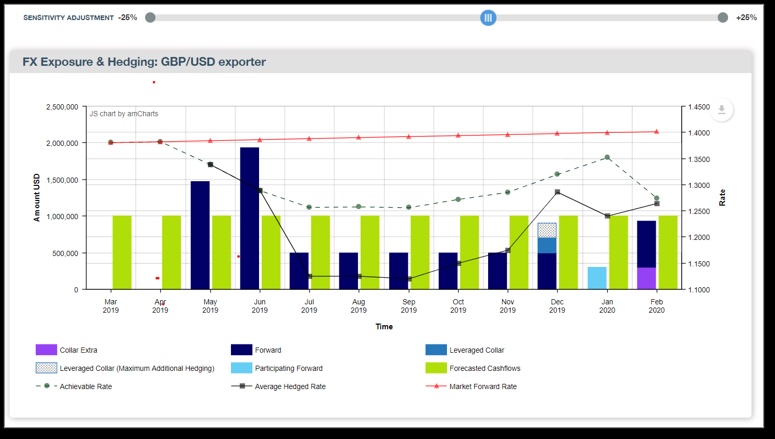
“I can move the sliding scale on the FX Exposure Tool and see if I’m in the money, or out the money. I can even put a deal in to see what it would look like before I take the trade and work out whether I really need the deal or if it’s too much risk.”
Day‑to‑day use of Hedgebook
Hedgebook is now used by Bidfood to enter, review and monitor FX deals and exposures on an ongoing basis. Deals are recorded line‑by‑line, with positions updating automatically over time rather than requiring manual spreadsheet adjustments.
A key improvement has been shared visibility. Hedgebook allows multiple stakeholders to independently access the same live information, removing the need for repeated spreadsheet exports. As David Hansford is responsible for buying and entering the data he particularly appreciates the transparency.
“The best part about it is my work now is open – the import manager can see it – our CFO can just log in and see what’s going on. It’s open to the company.”
The Bidfood team also value being able to see blended and achievable rates without performing manual calculations:
“It splits out each deal for you and shows your blended rate per month and achievable rate per month, which is very handy,”explains David.
Key Outcomes and Benefits from Using Hedgebook
By moving FX management back into Hedgebook, Bidfood has improved confidence in the accuracy of its FX position. Graphical and tabular views make it easier to understand exposure at a glance and explain it to others.
“It caters to both visual users and those who prefer working with tables. The data can be downloaded and used however people need,” explains Barry Plit. “Another big advantage is that it’s live – if a deal is date-driven, it updates automatically over time. As long as the inputs are correct, the view stays current, so there’s no need to keep adjusting a spreadsheet manually. I can simply look at it myself whenever I need to.”
The system supports Bidfood’s disciplined approach to hedging by clearly showing forward positions versus spot rates and coverage over time. This helps ensure decisions remain aligned with internal expectations rather than spreadsheet interpretations.
Hedgebook is pretty spot on
“Instead of me doing little calculations where I might miss something on a spreadsheet, I can trust this a bit more,” says David Hansford. “There might actually be more features in Hedgebook we can use, but for me, the bits we currently are using are pretty spot on.”
If you would like to explore how Hedgebook might work for your team – please reach out to set up a call with one of our experts.