
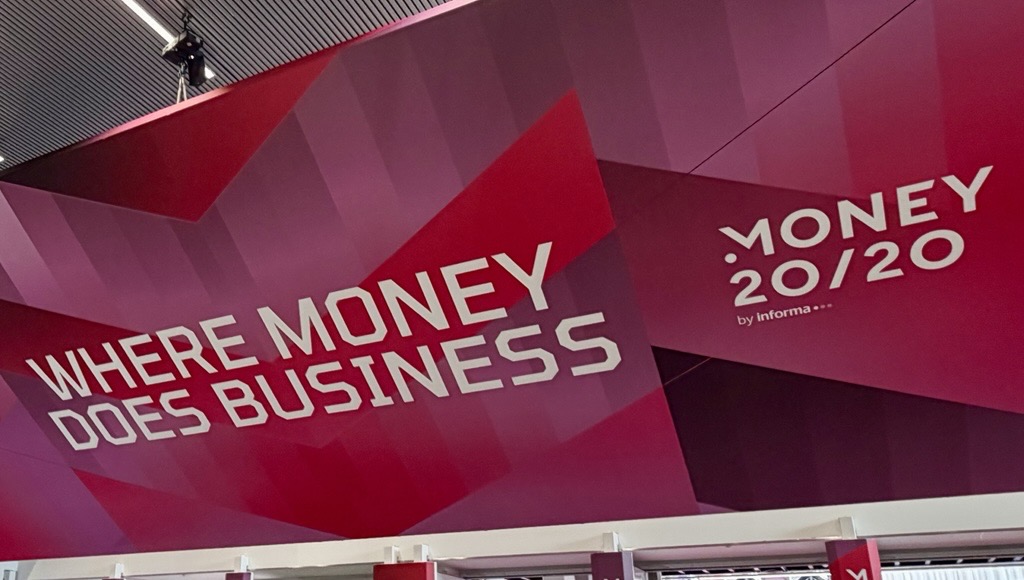
This year’s Money20/20 in Amsterdam leaned into a bold theme: Where TradFi meets DeFi. It’s a phrase we’ve heard variations of before, but in 2026 it felt less aspirational and more like reality.
If they’re not terms you are familiar with, TradFi and DeFi represent two distinct approaches to financial systems. While TradFi is rooted in tradition and regulation offering stability and trust, DeFi is driven by technology and decentralization – providing innovation and open access. Increasingly, the future of finance seems likely to involve a blend of both.
From the keynote stages to exhibition floors – and countless side conversations – it was evident the once distinct worlds of traditional finance (banks, brokers, payment service providers) and decentralised finance are no longer orbiting separately. They are converging. And increasingly, they are doing so with purpose.
Stablecoins step into the spotlight
If there was one technology that dominated the agenda, it was stablecoins.
Session after session explored stablecoins emergence as a mainstream settlement vehicle. The narrative is now well-established: stablecoins promise faster, cheaper, and more programmable cross-border payments – something the industry has been chasing for decades.
What struck me most wasn’t just the volume of discussion, but the level of conviction. For most of the participants I spoke with, stablecoins are no longer experimental – they are inevitable.
That said, not everyone is convinced they are a silver bullet. A minority of voices, particularly those focused on emerging markets, highlighted that the core problem isn’t necessarily the payment rails themselves. Instead, they pointed to liquidity constraints and regulatory fragmentation as the real barriers to progress.
These dissenting views were valuable, if outnumbered. They served as a reminder that while the technology is compelling, its success will ultimately depend on how well it integrates into real-world financial ecosystems.
Agentic AI: the other ubiquitous conversation
Alongside stablecoins, another topic seemed to be everywhere: Agentic AI. If previous years were dominated by ESG, this year marked a clear shift. Artificial Intelligence – and more specifically autonomous, decision-capable AI systems – is now very much front and centre.
However, the term “AI” is still being used to describe a very broad and sometimes ambiguous spectrum of capabilities. From simple automation to fully autonomous agents, the range is vast, and definitions are often inconsistent.
My sense is, over the next 12 months, the market will push toward greater clarity and specificity. We’ll move beyond buzzwords and start to see more precise descriptions of what ‘AI-enabled’ products actually do – and, more importantly, the tangible value they deliver.
A boom in payment infrastructure
Walking the exhibition floor, one thing was impossible to miss: the sheer number of payment infrastructure providers.
From early-stage disruptors to rapidly scaled fintechs, the space is clearly booming. Many of these businesses have experienced remarkable growth in a short period of time, driven by demand for modern, flexible, and globally scalable payment solutions.
This proliferation raises an interesting question: as the market matures, how many of these players can sustain their momentum? Consolidation feels inevitable, but for now, innovation is thriving.
Buy vs Build: a debate that won’t go away
From a risk and product perspective, one debate remains as relevant as ever: buy vs build. There’s no universal answer, but the consensus at Money20/20 seemed to be shifting -albeit slightly – towards outsourcing specialist capabilities.
The reasoning is straightforward. As financial products become more complex, organisations are recognising that deep expertise in niche areas (whether that’s Risk Management, fraud prevention, compliance, or payments orchestration) is difficult and costly to replicate in-house.
Instead, many are opting to partner with best-in-class providers to fill gaps quickly and effectively. We covered this topic in an earlier blog article which may be of interest if this topic resonates with you.
Connectivity is evolving: enter MCP
Of course, outsourcing creates its own challenge – integration. Seamless connectivity is now a critical requirement, and interestingly, even APIs – once the gold standard – are coming under the spotlight.
A new concept that came up (and one that was new to me) is the Model Context Protocol (MCP). The simplest way to think about MCP is as a kind of “USB-C for AI and data systems.” It enables two-way interaction with external services and data sources without the need for traditional coded integrations.
It’s early days, but the idea is compelling. If MCP (or something similar) gains traction, it could significantly reduce the friction associated with integrating complex ecosystems -a key requirement in an increasingly modular financial services landscape.
The human element still matters
Beyond the themes and technologies, it’s worth reflecting on the event itself. Money20/20 remains a huge gathering, but this year it felt slightly more manageable and easier to navigate. More importantly, it seemed to rediscover something that felt diminished in the immediate post-Covid years: high-quality, in-person connection.
Many of the best interactions weren’t planned. They came from chance encounters, familiar faces, and spontaneous conversations that turned into meaningful discussions.
Encouragingly, these weren’t just surface-level exchanges. Conversations were focused, relevant, and productive, and have already translated into a number of valuable follow-ups.
Final Thoughts
Money20/20 Amsterdam 2026 reinforced a simple but powerful point: financial services is entering a phase of practical convergence.
- TradFi and DeFi are no longer competing narratives—they are becoming complementary.
- Stablecoins are moving from concept to application.
- AI is evolving rapidly but needs clearer definition.
- Infrastructure is expanding but so is the need for integration and specialisation.
Above all, Money2020 reminded me that while technology continues to accelerate, relationships and collaboration remain at the heart of progress.
Would I recommend it? Absolutely. Will I be back? Without question. Do I want to talk about what I learnt? Anytime.