

29 April 2026
Treasury Risk Management Solutions (TRMS) Guide for Corporate Treasurers
What a TRMS is, how it differs from a TMS - and why Hedgebook is the TRMS of choice for corporate treasurers, FX sales teams and auditors around the world to manage FX, interest rate and commodity risk.
Corporate treasurers are expected to protect budget rates, communicate risk clearly to the board and deliver audit ready evidence – mostly under tight cost and time constraints.
Treasury Risk Management Solutions (or TRMS) exist to meet those expectations: they centralise exposures, structure and track hedges, model scenarios and produce independent valuations with reporting aligned to IFRS and US GAAP.
Independent industry bodies consistently recommend specialist technology over manual or fragmented approaches. As the Association of Corporate Treasurers (ACT) summarises:
“Specialist treasury management technology enables data to be collected, collated and presented in a consistent format with sophisticated capabilities to refine forecasts… Those who use specialist, treasury technology reported better performance and, therefore, greater confidence in the underlying cash flow and risk data on which decisions are made.”
ACT, The Treasurer (Three steps to risk management confidence)
PwC also cautions:
“The use of manual processes or in‑house developed systems could hinder the timeliness, accuracy and auditability of risk insights.”
PwC, 2025 Global Treasury Survey
What a Treasury Risk Management Solution (TRMS) should deliver
A credible TRMS should cover six core capabilities:
- Exposure capture and visualisation – a single view of forecast cashflows, hedges and cover ratios
- Scenario modelling and decision support – test rate moves and alternative strategies in P&L terms
- Hedge policy tracking – surface board approved limits and monitor compliance over time
- Independent valuations – audit-ready mark-to-markets sourced from recognised market data
- Reporting packs and evidence trail – repeatable outputs for boards, auditors and management
- Integration, security and speed to value – secure data exchange, encryption and fast implementation

1. Exposure capture and visualisation
Treasurers need a single source of truth that ties forecast exposures and hedges together. A TRMS should show cover by month, hedge rates, timing and budget protection – in a visual that makes board conversations straightforward.
Ideally the TRMS will be able to combine forecast exposures with FX forwards and structured options (e.g. collars, participating forwards) to present the hedging position clearly across time horizons.
Where structured products are used, treasurers need transparency on protection, participation and obligation amounts and rates. These products are complex and it is crucial to understand the potential outcomes under current and hypothetical future FX market rates.
In all cases this needs to be presented in a widely understood format and available to all stakeholders including senior management, liquidity providers and treasury advisors.

2. Scenario modelling and decision support
“What happens if the currency moves five cents?” A TRMS should let you test shifts in market rates and alternative hedging strategies quickly and convert them into P&L views, hedge ratios and achievable rates that stakeholders understand.
Treasury teams then use those outputs to transact new hedging, often within policy limits. Decisions are made within an environment of control and compliance rather than reacting emotionally to volatility and a single view is shared by the treasury team and its liquidity providers.

3. Hedge policy tracking
Most corporate policies follow a layered approach: higher coverage in near months where cashflows are more probable; lower coverage further out where forecasts are less firm.
A TRMS should surface board approved minimum/maximum risk control limits in the exposure view, so hedging decisions are made regularly over time and avoid large commitments at single points of time.
As best practice, policy guidance encourages a layered hedging approach to reduce volatility through small, regular decisions rather than large, reactive ones.

4. Independent valuations (audit‑ready)
Treasurers need independent mark-to-markets for financial instruments (FX forwards, FX options and interest rate swaps) – monthly or on demand. A TRMS should provide third party valuations sourced from recognised market data, with concise reports suitable for management and audit.

5. Reporting packs and evidence trail
Boards and auditors expect concise, repeatable information: sensitivity reporting, portfolio views and an audit trail. A TRMS should generate these materials without spreadsheet reconciliation with inbuilt audit trails and reporting designed to withstand scrutiny.

6. Integration, security and speed to value
Risk tooling must fit into existing processes. A TRMS should offer secure data exchange (for deal loading and valuation retrieval), follow best practice encryption and be fast to implement.
It should also be intuitive and easy for your treasury team to use. That means being securely accessible no matter where they are located and with a flow and layout they can instantly relate to.
Ready to discuss your team’s TRMS needs?
Find out how a purpose-built Treasury Risk Management Solution fits your workflow.
Why Hedgebook’s a TRMS of choice for corporate treasurers
While this guide is essentially an overview of what Treasury Risk Management Solutions, treasurers often ask which platforms align cleanly to the capabilities described. We believe Hedgebook is setting the standard for an easy-to-implement, affordable TRMS solution that delivers strongly across all corporate treasury requirements. Here is why:
- Clear exposure and scenarios – single or multi-currency views with cover, hedge rates and policy limits
- Scenario modelling – turn “what ifs” into board-ready decisions
- Policy limits clearly displayed – at-a-glance compliance checking
- Independent valuations and IFRS alignment – proprietary models across FX and interest rate instruments
- Audit confidence and adoption – used by 75% of the UK’s Top 30 audit firms
- Reporting packs and traceability – audit-ready reports for stress-free year-end
- Integration, security and quick set up – Public API, two-way encryption and ~24 hour implementation
1. Clear exposure and scenarios (single or multi‑currency)
- Consolidates forecast exposures and hedges in one view; shows month by month cover, hedge rates, timing and policy limits.
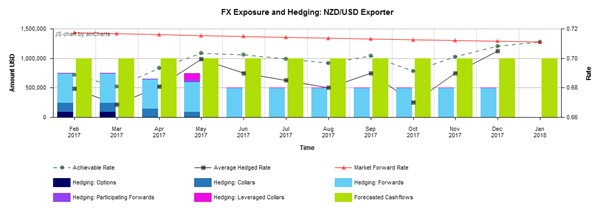
- Supports FX forwards, as well as a vast array of vanilla and complex option structure products so you can clearly understand the outcomes of these products under alternative market rates.
- Calculates indicative achievable rates by incorporating the unhedged portion of exposures so you have an accurate overview of the whole hedging picture.
2. Scenario modelling that turns “what ifs” into decisions
Clear, easy-to-use visualisation tools for scenario analysis of currency moves with outputs designed for board reporting. Option protection rates, participation rates, barrier rates and leverage ratios are all encompassed within the analysis.
3. Policy limits clearly displayed
- Policy limits/risk control limits are clearly reported against. See at a glance whether the hedging position is policy compliant.
4. Independent valuations and IFRS alignment
Hedgebook’s proprietary valuation models provide independent valuations across financial instruments (FX forwards, FX options and interest rate swaps).
Supports Fair Value reporting of IFRS 13 including CVA/DVA, hedge effectiveness testing of IFRS 9/IAS 39 and the Sensitivity Analysis required by IFRS 7 — reducing effort at month end and year end.

5. Audit confidence and adoption
Hedgebook audit functionality is used by 75% of the UK’s Top 30 audit firms – a confidence signal for audit workflows and fair-value methodology.
6. Reporting packs and traceability
- Comprehensive, audit ready reports for financial reporting enables quick and stress-free year-end reporting or anytime reporting is needed.

7. Integration, security and a quick set up process
- Hedgebook Public API for deal loading and valuation retrieval (including complex option structures) with supporting documentation.
- SSL protocols and two‑way encryption.
- Typical corporate implementation within ~24 hours, designed for non‑technical users.
Use cases:
How Hedgebook delivers for corporate treasurers (using GBP‑USD examples)
The following examples show how Hedgebook supports common treasury workflows
- Budget rate protection – UK importer hedging USD costs with a participating forward
- Revenue smoothing – exporter using layered hedging across 12 months
- Independent valuations – monthly fair value marks for management and audit
- Board-ready reporting – quantifying budget protection ahead of updates
UK importer protecting a GBP budget rate with a participating forward
“Our buyers need to know the exchange rate on which to base negotiations. Hedgebook is a very intuitive and user-friendly system for capturing our FX transactions. We know with confidence our FX position which, in turn, allows our procurement team to negotiate with confidence. Reports on our FX exposures versus our future cashflows… means we have oversight on the P&L implications of fluctuating exchange rates.”
Chris Kinraid, former Group Financial Controller, Kathmandu
Objective: Protect USD costs while retaining participation if GBP strengthens.
Hedgebook view: Load the forecasted USD costs plus the GBP/USD participating forward (Sell GBP / Buy USD); the Exposure Tool displays the obligation portion at strike and the participation portion at market and calculates the indicative achievable rate. Alternative FX rate scenarios can be tested and Hedgebook will quantify P&L at risk, calculate hedge/achievable rate versus the budget rate and confirm hedging against policy limits.
Read the full story from global retailer, Kathmandu, here.
Monthly independent valuations for management and audit
“We typically do sensitivity testing for half year and end-of-year financial risk notes alongside the derivative valuations. Because Hedgebook does such a great job of managing what we do, we have been able to reduce the reporting frequency and the time it takes to produce reports has been greatly reduced.”
Kim O’Hara, Finance Manager at EROAD
Objective: Produce fair value marks on demand that satisfy IFRS and audit expectations.
Hedgebook view: Access Hedgebook’s proprietary models to run independent valuations for FX forwards, options and interest rate swaps; includes IFRS 7 sensitivity analysis and, where relevant, CVA/DVA for IFRS 13; auditable financial reporting compliance.
Read the full story as to how telematics provider, EROAD, uses Hedgebook here.
Implementing Hedgebook TRMS – an overview for treasurers
Implementation should be fast, structured and minimally disruptive. Hedgebook is designed for non‑technical users and is typically implemented within ~24 hours, making it feasible to move quickly from scoping to first reporting. At a high level>>
- Scope and data readiness: confirm currencies, forecast cashflows and existing hedges so the initial exposure view is complete.
- Policy & budget rates: reflect board‑approved minimum/maximum cover limits and budget rates directly in the exposure view to enforce decision discipline.
- Exposure & scenarios: configure the FX Exposure Tool and run initial scenarios; align visuals and tables to board reporting needs.
- Valuations workflow: independent valuations for FX forwards, options and interest rate swaps are always available. Plan ahead for key reporting periods with confidence. IFRS and US GAAP-aligned reporting.
- Optional connectivity: use the Public API to automate deal loading and valuation retrieval.
- Security & access: Hedgebook is ISAE 3402 audited and meets your IT and compliance requirements. Strong data and privacy protocols with SSL and two‑way encryption. Access can be provided on a role‑based basis for treasury, finance and advisors. Delivered via cloud technology so accessible from anywhere/anytime.
Get a quick quote for your team or check out our handy guide to implementing Hedgebook TRMS
TRMS FAQs for corporate treasurers
A TRMS centralises exposures, hedging workflows, scenario modelling and independent valuations across FX, interest rate and commodity risk, producing IFRS/US GAAP‑aligned reporting and audit evidence.
A TMS focuses on cash, payments and bank connectivity; a TRMS focuses on market‑risk insight, hedging, scenarios and fair‑value reporting. Many treasurers run both layers.
At minimum: FX forwards, FX options and interest rate swaps – with daily market data and concise reporting suitable for audit.
Hedgebook is typically implemented within 24 hours and is designed for nontechnical users.
Yes. Hedgebook’s Public API supports secure deal loading and valuation retrieval, with documentation and a test environment for integration.
Closing note on TRMS for treasurers
When the question is “Are we protected and can we prove it?”, a Treasury Risk Management Solution should give treasurers the levers to answer decisively: consolidated exposures, scenarios that explain outcomes and independent valuations that withstand scrutiny. Use the criteria in this guide to evaluate tools, then test exposure clarity, scenario speed, valuation evidence and reporting in a demo.
We would happily be part of that evaluation. Let’s talk about how Hedgebook TRMS will work for you
Related Posts



Related Posts

Want to know the latest? Sign up to our newsletter.
Get irregular, sometimes irreverent, updates from the Hedgebook team.